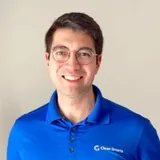
Brent Monson
Co-Founder
Brent thinks about product the same way he thinks about the people using it — methodically, with an eye on what comes next. He was the only engineer behind Clean Smarts for its first two years, building the multilingual and offline capabilities no competitor had. Integrity and long-term thinking are how he works.
Brent Monson co-founded Clean Smarts and wrote the first version of it himself. For two years he was the only engineer on the product — scheduling, time tracking, inspections, payroll — built to the standard he’d learned writing financial systems that had to be correct at scale, every time, for publicly traded companies.
Why he took the problem seriously
Guillermo Rojas came to him in 2016 with a problem from inside the cleaning industry: crews he couldn’t see, work he couldn’t verify, and no software that closed the gap. Brent had spent his career on systems where “close enough” wasn’t acceptable, and he recognized the same class of problem — operational truth, documented and trustworthy.
They talked through what janitorial software would need to do that nothing on the market was doing, and came away with a name and a plan. Clean Smarts was incorporated in October 2016. First revenue arrived nine months later.
The calls he made early
Brent was the sole developer for the first two years. A few of his early decisions still separate Clean Smarts from other janitorial software:
- Multilingual from day one. The first customers already had multilingual teams, so internationalization was a launch requirement, not a later add-on. “I don’t know how competitors introduced Spanish late in their product development,” he says. The app supports more than 30 languages.
- Offline, when no one else was. He built punch-in/out to work without a connection. Most operational tools in competing platforms still require one.
- Bootstrapped, eyes open. He’d seen how investor pressure tilts a product company toward short-term growth. He and Guillermo chose to run lean instead, so the roadmap could follow what operators actually asked for.
- Always designing v-next. He thinks software has a short shelf life. Within a few years of shipping v1 of the mobile app, he assembled a great team and began tackling v2.
Most of the platform’s standout features — geofenced clock-in, QR-code location verification, the comprehensive meal and break compliance tracking that California clients pushed for, and payroll that replaced entire spreadsheet workflows (keep your own provider via export or sync, or run full-service payroll with Clean Smarts) — came out of the loop he set up: a customer asks, the team validates, it gets built properly.
Why documentation protects the cleaner
There’s a scene in UHF — yes, the Weird Al Yankovic movie — where a TV station executive fires the janitor for throwing away important documents, then discovers he’d left them on his own chair. Brent references it without irony. “I feel like janitors often get blamed as a reflex,” he says.
It shaped how he built the product. When cleaning work is documented — photos, timestamps, GPS check-ins, inspection records — accountability doesn’t only flow upward; it protects the person who did the work when a client points fingers after the shift.
The mobile app closes each shift with a line he added: “Thank you for making the world a cleaner place.” Small flourish, but it matters to him.
Find them online
Articles by this author
-
How to Win Commercial Cleaning Contracts: Why Consistency Beats the Lowest Bid
Bill and Mimi Kromah of Gifted Hands Cleaning Services never try to be the cheapest. Nine years in Sacramento taught them that brand recognition, references, and refusing to underprice are the actual way to win commercial cleaning contracts.
-
Government Cleaning Contracts: What Happens When Two Bids Tie
Gifted Hands Cleaning Services won a state cleaning contract on a coin flip. Mimi Kromah explains how government janitorial bidding actually works, and why showing up consistently beats low-balling.
-
How to Scale a Cleaning Business: 5 Days, 11 Hires, and a Contract They Almost Lost
Zach Brown and his wife Lauren went from two teachers to running a 20-person cleaning company in central Texas. The contract that changed everything landed with five days' notice and no crew ready.
-
Commercial Cleaning Client Relationships: Why 'No Complaints' Is a Warning Sign
Katarina Kai of Mass Commercial Cleaning explains why silence from a client isn't good news, how to actually collect feedback in commercial cleaning, and the question that saved an account she'd nearly lost.
-
How to Handle Customer Complaints in a Cleaning Business as You Scale
Trey Brown's family grew Office Pride from a couple of bank branches to 400 buildings across three states. The thing that kept clients happy through that growth wasn't being perfect. It was a complaint system that tracks every issue to resolution.
-
How to Start a Commercial Cleaning Business: Lessons From $10 an Hour to a Franchise
Matt Pencarinha left a corporate salary, took a $10-an-hour job, and bought his first accounts for $500. Here's what he learned about starting and growing a commercial cleaning business that actually scales.